Martha Jefferson by William G. Hyland Jr
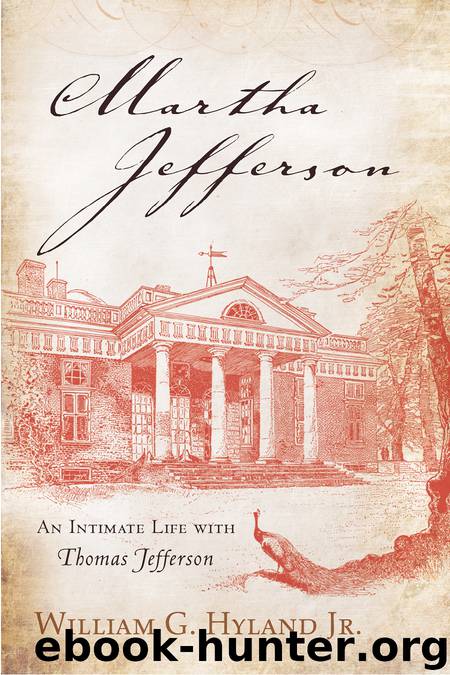
Author:William G. Hyland Jr.
Language: eng
Format: epub
Publisher: Rowman & Littlefield Publishers
Published: 2015-02-05T15:26:07+00:00
Twelve
The Governor’s Palace
Williamsburg could really be called a village rather than a town.1
— Philip Mazzei, neighbor of Thomas Jefferson
Before the Revolutionary War formally started, Thomas Jefferson returned alone to Williamsburg shortly after his daughter Jane was born. The assembly met again, in the wake of the Boston Tea Party and closure of the port of Boston. To protect his family, Jefferson insisted that Martha stay behind at Monticello. Busy running the house and plantation while raising her daughters, Martha still took the time to record those things Jefferson would want to know when he returned. She duly noted eating the most ripe cherries from the trees he had planted and first peas of the season. When Jefferson returned, he would proudly look over her journal and record her observations in his own garden book.
Much as he treasured the small pleasures of home, the torrent of public life was sweeping Jefferson away. As he looked back years later, he would describe his younger self as “‘bold in the pursuit of knowledge, never fearing’ to follow truth and reason to whatever results they led, and bearding every authority which stood in the way.”2 The stalking of truth and reason was about to become a very dangerous hunt, and one may wonder how Martha, a mother of three little girls, felt about her young husband’s willingness to take such bold risks for the Revolution. Jefferson was embroiled in controversy and formulating his first great statement of political philosophy, an incendiary pamphlet that would be printed, without his knowledge or consent—although not without pride—as A Summary View of the Rights of British America.
While Martha attended to family and the running of Monticello, in this season Thomas Jefferson, planter, lawyer, and provincial aristocrat, became a true revolutionary. In A Summary View, he rejected the authority of Parliament in America, arguing that although the colonies owed allegiance to the king, they elected their own representatives to local legislatures. The Continental Congress, then meeting in Philadelphia, would not tread that far. As one historian noted, “Jefferson must have known that his Summary View invited hanging.”3
He was on perilous political ground, but Jefferson situated his argument deeply and firmly in the terrain of his real life as an Albemarle County planter and lawyer, clearing his lands, traversing the breadth of Virginia, leaving his family for weeks on end. Should such a man’s fate be tied to a distant, negligent, sometimes abusive government? As he saw it, the original British colonists, like their Saxon ancestors, had left “the country in which they had been born.”4
On June 3, 1779, and in the midst of war, Jefferson was elected governor of Virginia by his colleagues in the state assembly. Martha and their daughters—Patsy, Polly, and Lucy—now took up residence at the magnificent Governor’s Palace in Williamsburg, although Jefferson could not have entertained notions of a lengthy stay. In fact, two days after his election, the Virginia Assembly passed a bill moving the government from Williamsburg to Richmond.
In those days,
Download
This site does not store any files on its server. We only index and link to content provided by other sites. Please contact the content providers to delete copyright contents if any and email us, we'll remove relevant links or contents immediately.
| Africa | Americas |
| Arctic & Antarctica | Asia |
| Australia & Oceania | Europe |
| Middle East | Russia |
| United States | World |
| Ancient Civilizations | Military |
| Historical Study & Educational Resources |
Cecilia; Or, Memoirs of an Heiress — Volume 1 by Fanny Burney(32561)
Cecilia; Or, Memoirs of an Heiress — Volume 2 by Fanny Burney(31958)
Cecilia; Or, Memoirs of an Heiress — Volume 3 by Fanny Burney(31944)
The Secret History by Donna Tartt(19097)
Sapiens: A Brief History of Humankind by Yuval Noah Harari(14392)
Leonardo da Vinci by Walter Isaacson(13339)
The Radium Girls by Kate Moore(12033)
Sapiens by Yuval Noah Harari(5374)
How Democracies Die by Steven Levitsky & Daniel Ziblatt(5221)
The Wind in My Hair by Masih Alinejad(5099)
Homo Deus: A Brief History of Tomorrow by Yuval Noah Harari(4921)
Endurance: Shackleton's Incredible Voyage by Alfred Lansing(4785)
Man's Search for Meaning by Viktor Frankl(4608)
The Silk Roads by Peter Frankopan(4537)
Millionaire: The Philanderer, Gambler, and Duelist Who Invented Modern Finance by Janet Gleeson(4481)
The Rape of Nanking by Iris Chang(4217)
Joan of Arc by Mary Gordon(4116)
The Motorcycle Diaries by Ernesto Che Guevara(4105)
Stalin by Stephen Kotkin(3970)
